
Checking Criminal History in Greeley
Start with the office that created the record. That matters in Greeley because the village does not keep a separate police file or court docket. Sheriff Paul Deaver's office handles the county law-enforcement route. The shared County and District Court counter holds filed charges, docket events, outcomes, and sentences. Nebraska State Patrol keeps the fingerprint-supported statewide Record of Arrest and Prosecution, often called a RAP sheet.
- Call the Greeley County Sheriff for a recent village incident, arrest report, booking status, or warrant question.
- Ask for the incident or arrest record by date, Greeley location, involved name, and report number if known.
- Search Nebraska JUSTICE with County set to Greeley for a filed County or District Court case.
- Use the shared court counter for free kiosk access, certified dispositions, older files, or images missing online.
- Order the NSP public RAP product when the question extends beyond the village or county.
Each Greeley record channel answers a different question. A Greeley sheriff report describes the response. Booking data shows intake and custody. The Greeley court file shows what the prosecutor filed and what the judge did. An NSP result compiles qualifying Nebraska events tied to fingerprints, but it does not replace the village incident report or the Greeley court file.
Greeley Village and Record Filters
“Greeley” can describe the village or the whole county. The distinction changes a Greeley record search. In JUSTICE, selecting Greeley County reaches cases filed for incidents across Greeley, Spalding, Scotia, Wolbach, and rural areas. A Greeley village street or event location may appear in the source report, but it is not a separate court filter. The same caution applies to an NSP criminal history, which covers qualifying Nebraska records rather than only Village of Greeley events.
Nebraska law also limits what an ordinary public RAP result can show. The official criminal-history dissemination statute illustrates those rules.
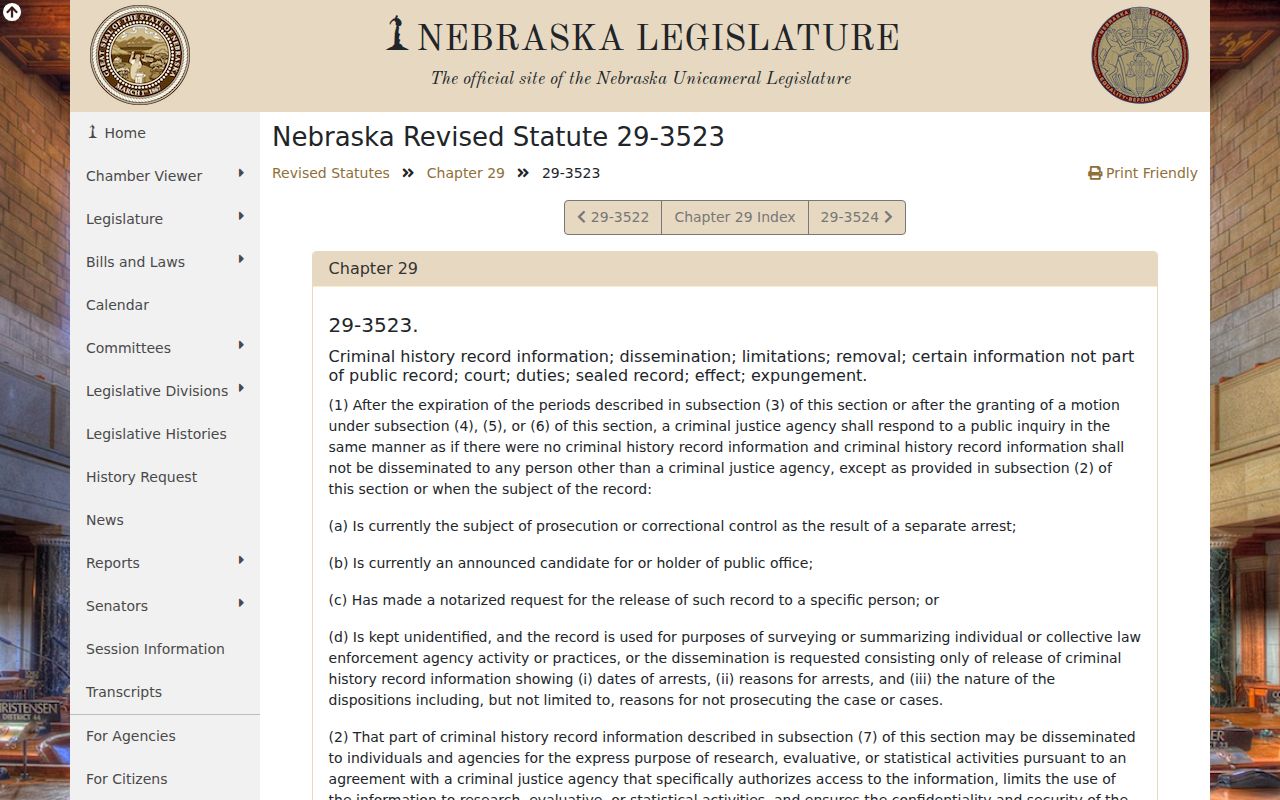
A blank statewide result does not prove that no Greeley incident, unfiled contact, out-of-state event, or Greeley source record exists. Check the Greeley sheriff and court channels before drawing that conclusion.
Note: Use “Village of Greeley” in a request when the event location might otherwise be confused with a countywide search.
Greeley Police Department Records
No independent Village of Greeley Police Department, police records unit, report form, blotter, or law-enforcement app was verified. The practical Greeley records contact is the Greeley County Sheriff. County board records describing interlocal law-enforcement agreements with the villages support this countywide model. A Greeley requester should not spend time looking for a village police desk that official sources do not identify.
The sheriff can be reached at 308-428-2395, by fax at 308-428-4905, or by mail at P.O. Box 248, Greeley, NE 68842. Ask for the specific product needed, such as an incident report, arrest report, booking sheet, jail information, warrant status, or public media. Include the date, village location, involved person, and event number when known. If a Nebraska State Patrol trooper made the stop, the source report remains with NSP even when the case later appears in Greeley County Court.
Greeley Criminal Records Counter
Greeley's county-seat role gives village residents a useful local access point. County Court and District Court share one public counter at 101 South Kildare Street, Greeley, Nebraska 68842. Michelle Soto is listed at 308-428-2705 and michelle.soto@nejudicial.gov. The counter is open from 8:00 a.m. to 4:00 p.m. on weekdays and closes on weekends and holidays. Mail may be sent to P.O. Box 302, Greeley, NE 68842.
Greeley Court Offices
101 S. Kildare St.
Greeley, NE 68842
308-428-2705
Weekdays, 8:00 a.m.-4:00 p.m.
The Greeley counter can supply certified dispositions, explain copy options, and help locate unavailable public documents, though staff cannot give legal advice. Online access through Nebraska JUSTICE is paid. The Greeley courthouse kiosk offers the same case information without the online search charge. Check the county calendar before traveling because published County Court Days, District Court dates, holidays, and office closures affect a small traveling-court system.
Greeley Arrests and Bookings
A Village of Greeley arrest starts with the sheriff or the agency whose officer made the stop. The officer creates an incident or arrest report. A designated jail then creates intake data, takes fingerprints and a photograph, lists the received charges, and records bond, holds, housing, transfer, or release. The county attorney later decides which allegations to file. Those filed charges can differ from what appears on the booking sheet.
There is no verified Greeley village jail, county live roster, daily arrest blotter, or booking app. The sheriff manages the Greeley booking function, but county board records document payments to a neighboring sheriff for inmate housing. Call first. Ask whether the person was booked, released, transferred, or physically lodged for Greeley County elsewhere. Once the receiving facility is known, use that facility's current custody channel. The broader county process and all official fallbacks are detailed in the Greeley County arrest lookup.
Recent Greeley custody may appear before a court case does. JUSTICE and the Greeley court calendar become useful after filing, while the NSP RAP product depends on fingerprint and disposition reporting. None is a real-time village roster.
Greeley Records Without a Lobby
The sheriff's official page gives a post-office box, phone, and fax, but no street counter address or public lobby hours. Do not assume the courthouse is the sheriff's walk-in desk. Call 308-428-2395 before traveling. Confirm where records requests are accepted, whether an appointment is needed, and where a written request should go. The county's public-records page does not supply a criminal-record form or request portal.
A focused Greeley records request should name the Village of Greeley location, date or date range, agency, people involved, and exact record sought. Ask for electronic copies where practical. Request an estimate before chargeable work because no Greeley report or certification fee schedule is published. If the office does not hold the record, ask which agency created it. If access is denied or material is redacted, request the legal basis for that decision.
Call before a walk-in. The sheriff's P.O. box is a mailing address, not a verified public lobby or inmate-mail address.
Municipal Court Records in Greeley
The Village of Greeley has no verified municipal court or municipal case portal. Nebraska County Court handles Greeley ordinance allegations, traffic matters, misdemeanors, and the preliminary stage of felony cases. A Greeley felony bound over for trial proceeds in Greeley County District Court. Both courts use the same Greeley records counter and the statewide JUSTICE case system.
| Court Name | Greeley County Court; District Court for bound-over felony trials |
|---|---|
| Case Types Heard | Village ordinance, traffic, misdemeanor, felony preliminary, and felony trial matters |
| Case Lookup Channel | Nebraska JUSTICE online or the free courthouse kiosk |
| What the Docket Shows | Case number, parties, charges, register of actions, public orders, disposition, sentence, and financial entries |
| Copies & Fees | Ask the shared clerk counter for current plain-copy, certified-copy, and archive costs |
Read each Greeley charge and disposition. Counts in one Greeley case may end in different ways. The overall Greeley case label “closed” does not say whether a count was dismissed, amended, resolved by plea, tried, or diverted. For a document missing online, contact the Greeley clerk rather than assuming it is sealed or nonexistent.
Greeley Criminal Record Classifications
Greeley court records identify the statute and classification for each filed count. Felony preliminary matters begin in County Court, but felony trial and judgment belong in District Court. The official Nebraska felony penalty table provides the current class framework.
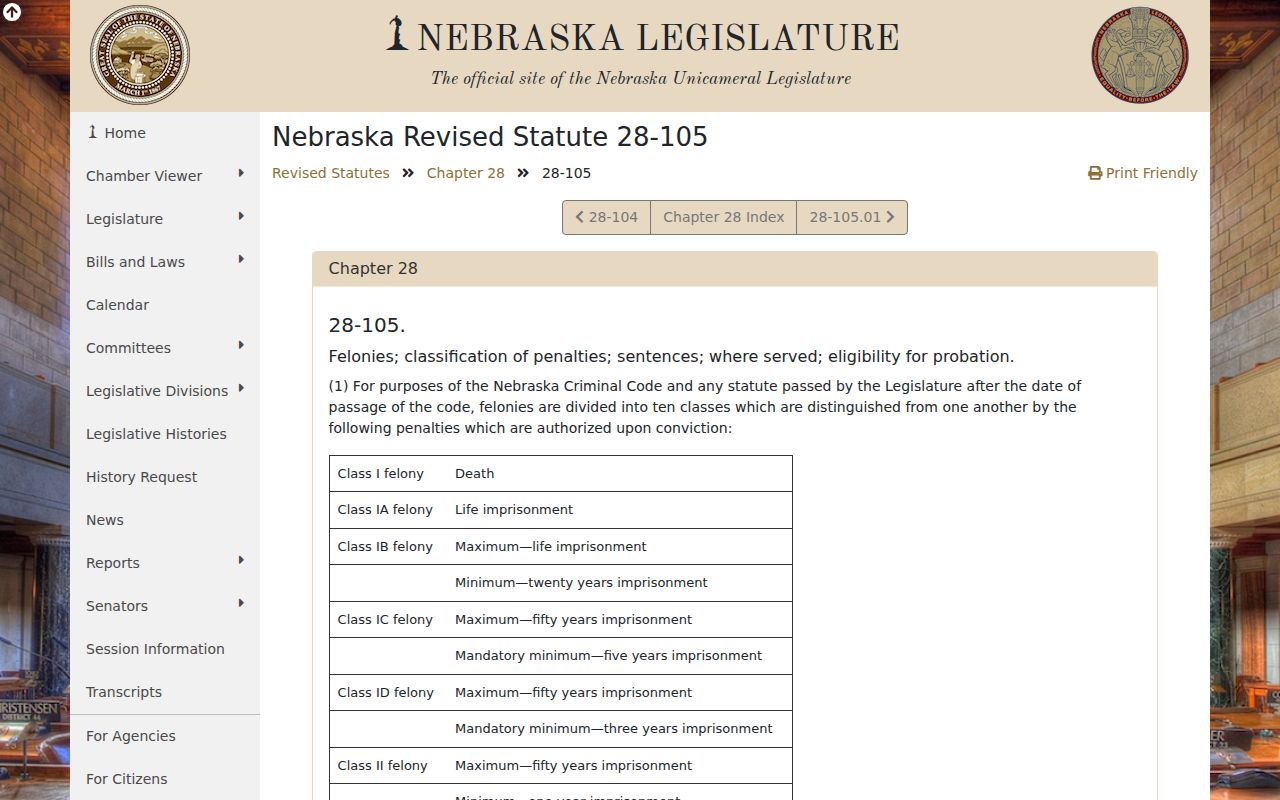
The class alone is not the outcome. Mandatory minimums, enhancements, the exact statute, the plea or verdict, and the sentencing order control the specific Greeley case.
Most misdemeanors and ordinance cases remain in County Court. The Nebraska misdemeanor penalty table supplies a separate set of classes.
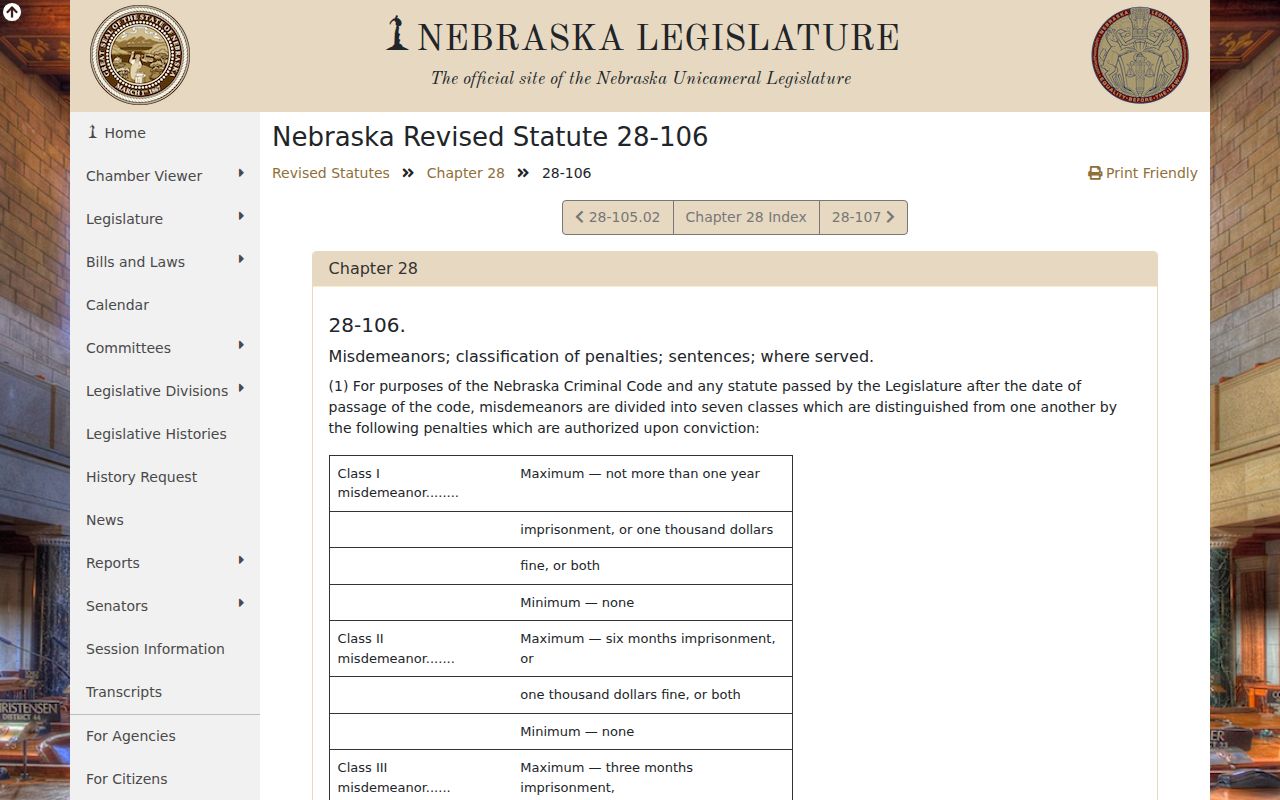
Use the docket to connect a class to a filed count, then read that count's final disposition and sentence. A penalty table describes authorized ranges. It does not prove what happened in a particular Greeley criminal record.
Where Greeley Records Go
A Greeley event can produce several records as it moves through the local system. The sheriff or other responding agency keeps the incident narrative. A designated jail holds booking data. County Attorney Joseph McNally reviews the evidence and decides what to file. County Court receives misdemeanors, traffic and ordinance cases, plus felony preliminary matters. District Court receives a felony after bind-over. Court disposition reporting should then flow to the Nebraska State Patrol repository.
Record flow: Village incident › Greeley County Sheriff or source agency › Greeley County Courts › Nebraska State Patrol Criminal Identification Division
Timing explains why the sources may disagree at first. Booking allegations reflect intake. The complaint or information reflects the prosecutor's charging choice. The court docket tracks later changes, judgment, and sentence. NSP links fingerprint-supported Nebraska arrest cycles with dispositions reported to the repository. For a very recent Greeley event, begin locally. For the final outcome, use the court file.
Greeley Criminal Charge Path
The Greeley County Attorney is the charging office, not the village or the clerk. Joseph McNally's official county page lists felony and misdemeanor prosecution among the office's duties and links a diversion service. Diversion is a program that may permit a filed matter to be dismissed after a participant completes set terms. Eligibility and the resulting docket entries depend on the specific case and program.
- Complaint
- The first written allegation commonly filed in County Court.
- Bind-over
- The transfer of a felony from its County Court preliminary stage to District Court.
- Information
- The prosecutor-filed charging document used for a felony case in District Court.
- Disposition
- The result of a charge, which may differ from the original booking allegation.
These terms help a searcher follow the Greeley criminal docket without treating the first charge as the last word. The Greeley clerk keeps the public file, but cannot interpret strategy or advise a party. The prosecutor represents the state, not the accused. Questions about appointed counsel arise in Greeley court, since no separate county public defender office is listed.
Set-Aside Limits on Greeley Records
Nebraska's main conviction remedy is called a set aside. It is not full erasure. Under Neb. Rev. Stat. §29-2264, a person applies to the court that imposed sentence after completing the sentence, probation, or fine. The court weighs rehabilitation and the interests of the person and the public.
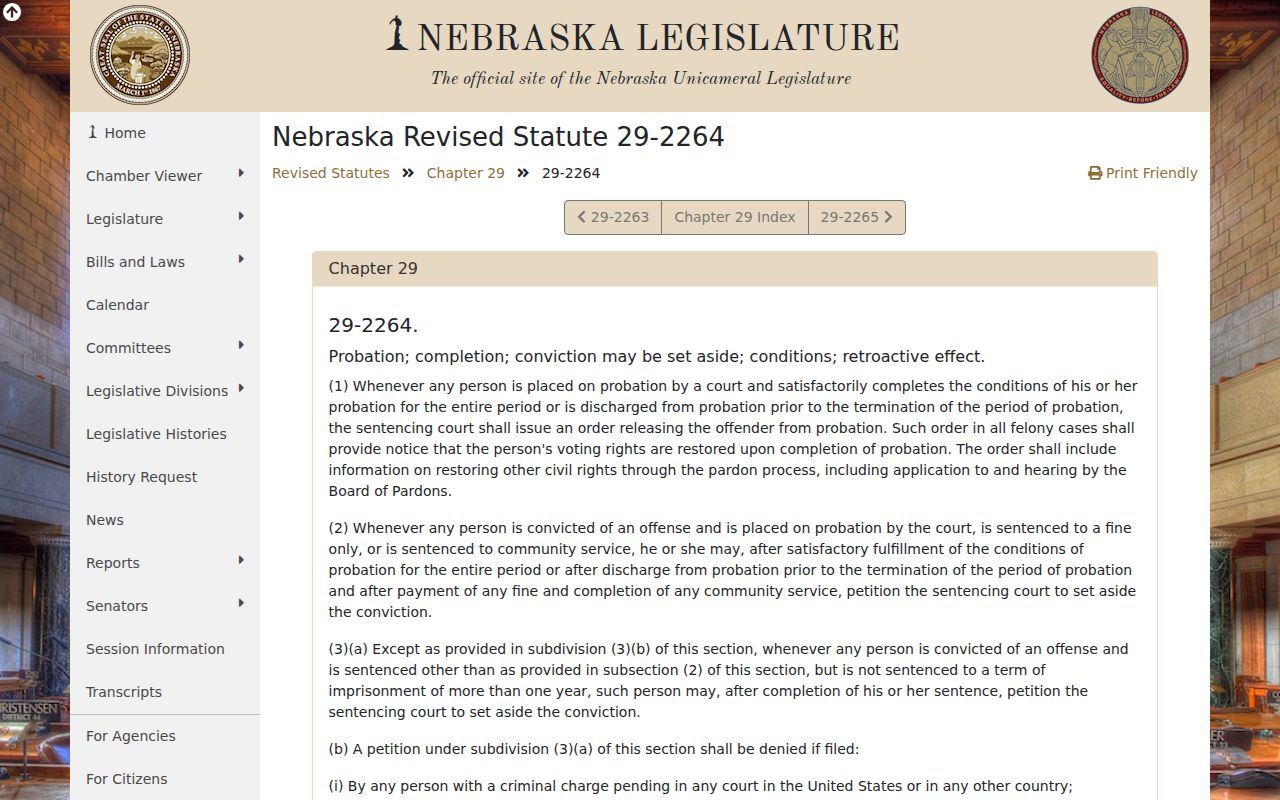
A granted order nullifies the conviction for specified purposes, but the case and set-aside order may remain visible. For a Greeley case, use the sentencing court at the shared Kildare Street counter, obtain the current Judicial Branch form, and ask about local filing steps. Keep certified copies of any order. Then compare the court file with an NSP self-review and send a factual correction through the office that created the wrong data.
Qualifying Greeley nonconviction information may become nonpublic under §29-3523, while true expungement is much narrower. Juvenile sealing follows a separate process. Identify the exact Greeley disposition and source record before choosing a remedy.
Public Access Rules in Greeley
Village-related records remain subject to Nebraska access law even though county and state offices keep them. The correct custodian still matters. Ask the sheriff for the incident or booking source, the clerk for the filed case and disposition, and NSP for the repository compilation. Active investigations, juvenile information, sealed files, victim or minor details, medical data, Social Security numbers, and financial-account data may be withheld or redacted.
Key Statutes:
Nebraska Public Records Act, §84-712 gives a general right to inspect and copy public records, subject to lawful exceptions and fees.
Neb. Rev. Stat. §84-712.03 provides routes to challenge a denial and seek an accountable custodian response.
Neb. Rev. Stat. §29-3506 defines criminal-history record information and separates a repository record from source files.
Describe a record instead of asking an office to investigate or answer a broad question. A precise date, Greeley location, case number, and record type can shorten the custodian's search. Public access does not make a record complete or current. Verify key facts with the originating office, and never infer guilt from an arrest or secrecy from a blank result.